Overview
Smart Campaigns helps small-business owners, many with little marketing experience, drive growth without having to manage campaigns themselves. Instead of relying on one-size-fits-all promotions, the product uses store performance data and DoorDash customer insights to automatically deliver personalized offers within a single campaign, maximizing net sales while balancing promotional costs.
As the sole designer on this 0→1 product, I owned the end-to-end merchant experience, from campaign creation and management to performance reporting and optimization. I defined the product vision, led the research that shaped key product decisions, and designed every core workflow. My work established how merchants interact with, understand, and measure automated marketing on DoorDash.
Who I designed for
Small-business owners wear every hat: operator, marketer, accountant, and customer support. Most have limited time, little marketing expertise, and can't afford to experiment with tools that might not work.
Research showed they weren't looking for more campaign controls or ad know-how, they wanted a system they could trust to make good decisions for them. So Smart Campaigns had to feel less like an ads tool and more like a trusted business assistant: one that automates decisions while giving merchants confidence their money is well spent.
"I can't afford to keep spending money to make money. If it's going to cost me money to make money, I don't have the money to spend."
DoorDash marketing felt like a gamble: too many choices, too little confidence
DoorDash offered 15+ ads and promotion products, each with different setup requirements, costs, and tradeoffs. For small-business owners already stretched thin, choosing the right strategy often felt overwhelming.
Many merchants couldn't distinguish ads from promotions or identify the right tool for their goals, so they set up suboptimal campaigns, and often lost money.
"Most promotion budgets get wasted on people who would have ordered anyway."
The opportunity: Not another marketing tool, but a single, AI-powered system that could make smarter marketing decisions on merchants' behalf while preserving their sense of control.
Setting the north star
Before designing screens, I aligned stakeholders across Design, Product, Research, Content, Data, and S&O around a shared vision for Smart Campaigns.
Rather than starting with features, we identified the core adoption barriers for SMB merchants and translated them into principles that would guide the experience. The result was a simple framework:
Be transparent
Help merchants understand how Smart Campaigns work, what data powers recommendations, and how decisions are made.
Give control
Provide lightweight controls over budgets, timing, and campaign settings while allowing automation to optimize performance.
Communicate value
Clearly connect campaign performance to merchant goals through understandable reporting and ROI visibility.
I concept-tested with 15 unmanaged and 7+ managed merchants across the three moments (discovery, activation, and reporting) and let the findings decide what shipped, and what didn't.
Designing the campaign experience
Design challenge
Small business owners needed to trust an AI to spend their marketing budget. Every manual control increased confidence, but reduced the AI's ability to optimize performance. My challenge was to find the right balance between automation and merchant control through research and iteration.
Defining the right controls
- Targeting: Fully automated. Research showed merchants were comfortable letting AI decide who to reach.
- Discounts: AI determined the incentive, while merchants controlled overall spend with a budget cap. This preserved model performance without taking away financial control.
- Promotion items: We launched with full automation, allowing merchants only to exclude items. When research and post-launch churn showed merchants wanted more control, I redesigned the experience with an item picker so they could choose what to promote. We later added a BOGO opt-out for merchants who wanted to run discount offers only.
Designing a simple setup experience
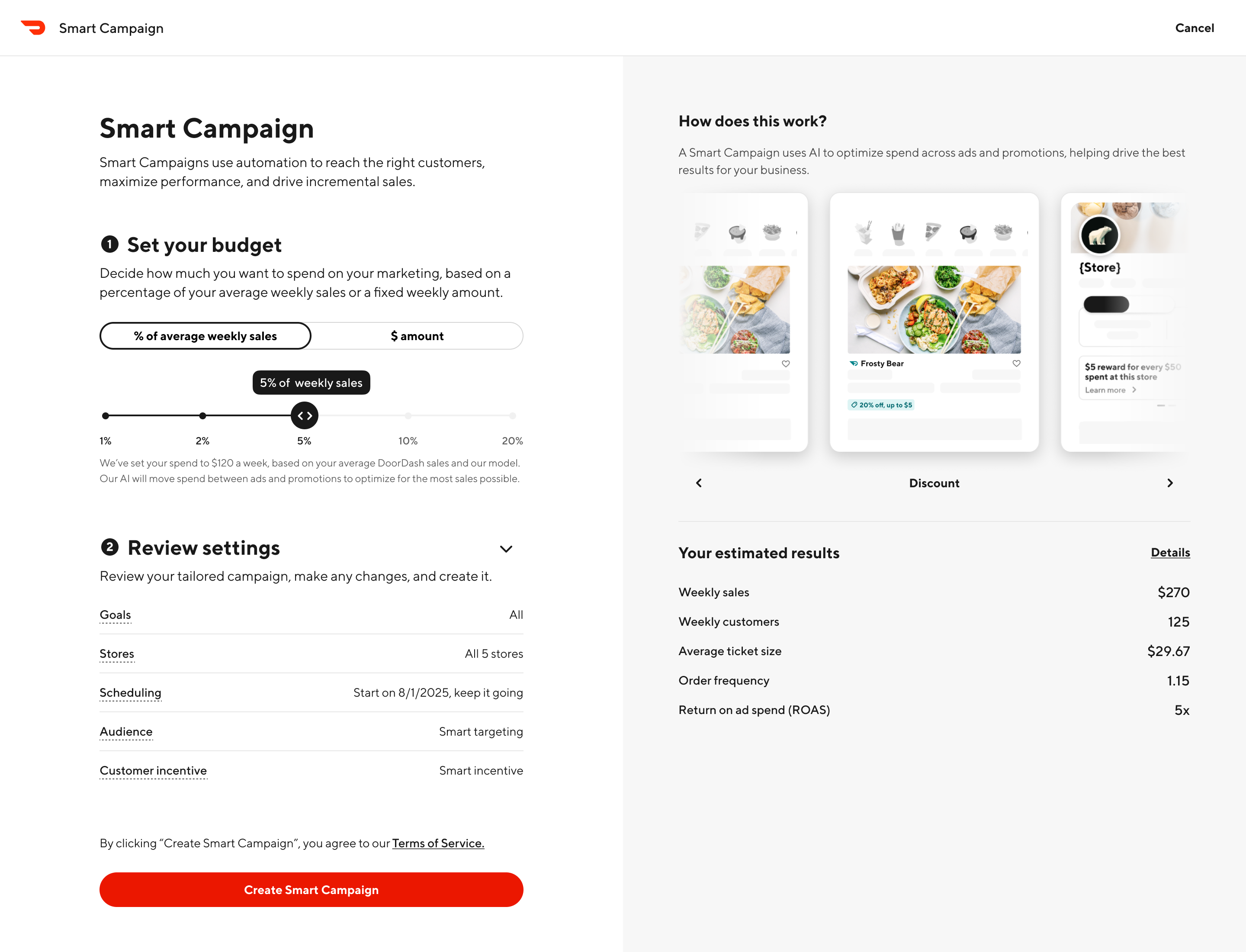
Once those decisions were defined, I redesigned the campaign creation flow to make setup feel lightweight without sacrificing confidence. I simplified core settings like campaign name, stores, schedule, duration, and budget, surfaced education only where it was needed, and added a live preview that showed where ads would appear along with projected performance. The result was a setup flow that felt transparent, predictable, and easy to complete.
"There's a plethora of my menu that I can't afford to discount."
"I want to see some ideas of who's gonna get what, a couple of samples."
Designing for discovery
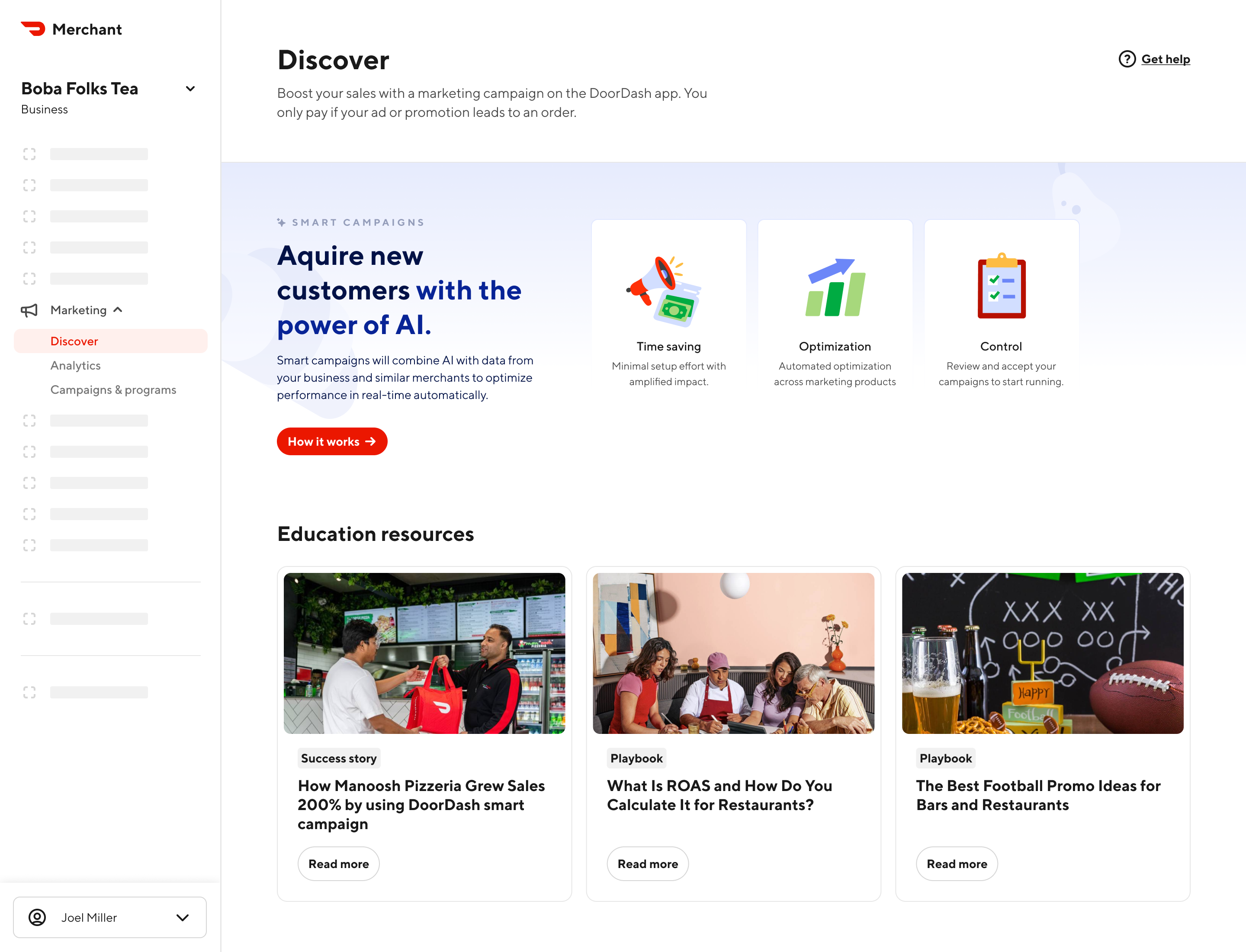
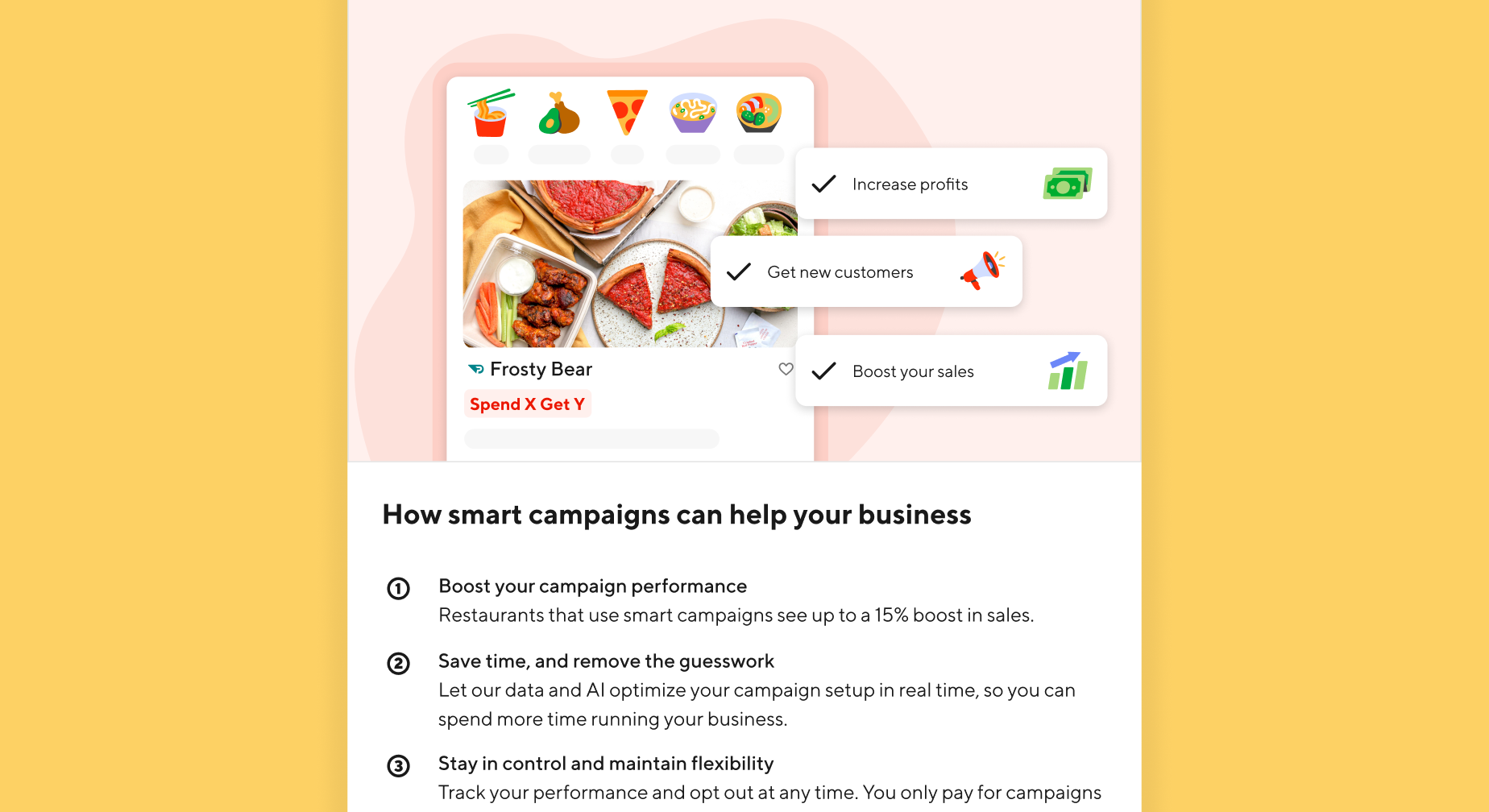
I designed a suite of discovery touch points to introduce merchants to Smart Campaigns and help them understand its value. These included marketing-page flyers, home-page recommendation cards, and “learn more” education modals. I also partnered with our video team to create motion assets for the discovery flyers, and designed the entry points that connected these surfaces.
AI-driven marketing is only as trustworthy as its reporting.
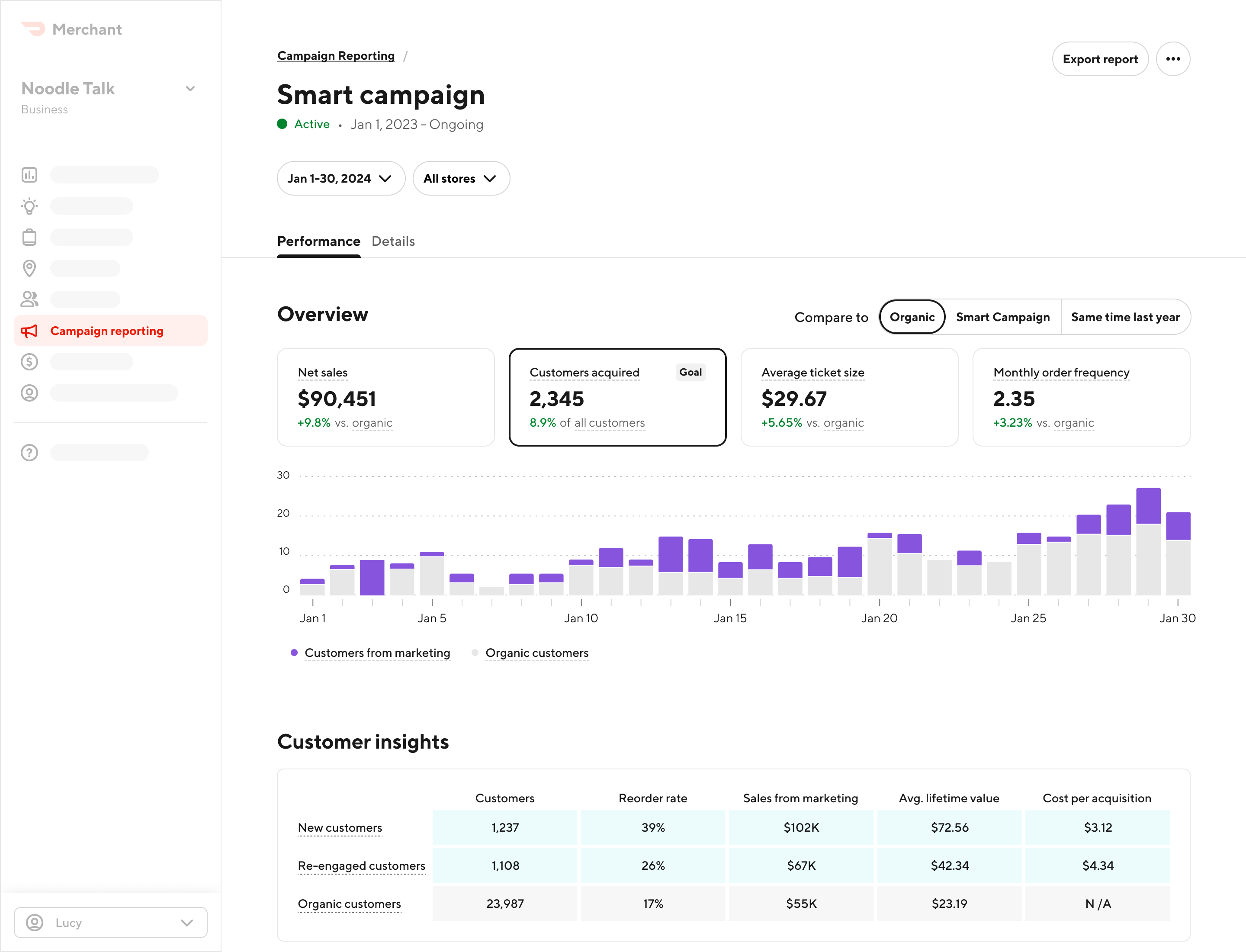
Merchants judged promotions by ROAS (return on ad spend), but Smart Campaigns optimized for incremental growth by reaching customers who wouldn't have ordered otherwise. As a result, ROAS could look worse even as campaigns drove real new growth. That mismatch made successful campaigns appear to underperform.
I redesigned reporting to bridge that gap by:
- Leading with incremental impact, highlighting new and re-engaged customers.
- Showing business contribution, comparing campaign-driven sales with total store sales so merchants could see the overall impact.
- Opened the black box. A "how your marketing spend is used" breakdown (which promotions drove orders, and how much went to new, lapsed, and existing customers).
"It's pretty clear, tells me exactly what I want to know. What we sold, how much we spent on that marketing."
The work moved the business
Smart Campaigns became the fastest-growing SMB product in DoorDash history. The product drove the results, but the reporting and controls I designed helped merchants understand its value, trust the AI, and keep using it.
"Set it one time and forget it, and then I have more time to focus on operations."
Key decisions and lessons
1Balancing simplicity and control
Merchants wanted automation, but also the confidence to step in when needed. Instead of maximizing customization, I built a few essential controls: budget, stores, campaign duration, and more.
Lesson: Adoption comes from giving users enough control to build trust, not every control they ask for.
2Making AI understandable
Skeptical merchants didn't want technical details or AI buzzwords. They wanted to know what was happening, why, and how it would affect what they cared about: net sales and take-home earnings.
So instead of selling the AI, I focused on plain-language explanations, visible inputs, and reporting that tied recommendations to results.
Lesson: People don't need to understand the algorithm, just what's happening, why, and how it affects their business.