TLDR;

Overview

I was part of the Small Business Ads team at Meta, which owned the ad tool on Facebook that helps small businesses grow their reach. We built an ads platform to power ad creation across the Meta family of apps on a single unified framework. In 2023 we shipped a native ads tool inside Messenger; in 2024 we set out to do the same for the WhatsApp Business app.

I embedded myself in my partner teams' worlds to understand their users' needs and constraints, so we could adapt ad creation to each platform's requirements. This case study covers our product strategy, building the ad tools from the ground up, and my role across surfaces.

Scope
2023–2024 · 0→1 ads platform spanning Facebook, Messenger & WhatsApp
My role
Platform design & systems strategy; end-to-end ad creation & management for Messenger
Team
25+ stakeholders across 3 teams — 2 product designers, 1 content designer, 2 PMs, 15+ engineers
Impact
~$20M annualized revenue; Messenger ad completion 1.3% → 4%
Setting context

The ads landscape at Meta

Meta offers advertising solutions that help businesses reach new customers across Facebook, Instagram, Messenger, and WhatsApp. Advertisers of every size use these platforms to promote their business, both organically and through ads.

We broadly categorize advertisers into three segments:

Segment 01

Basic

People with little to no marketing expertise, for whom advertising is just one part of their job.

Segment 02

Intermediate

More comfortable with advertising, but lacking the time or resources to become experts.

Segment 03

Advanced

Advertising professionals at agencies, or dedicated campaign managers at medium–large businesses.

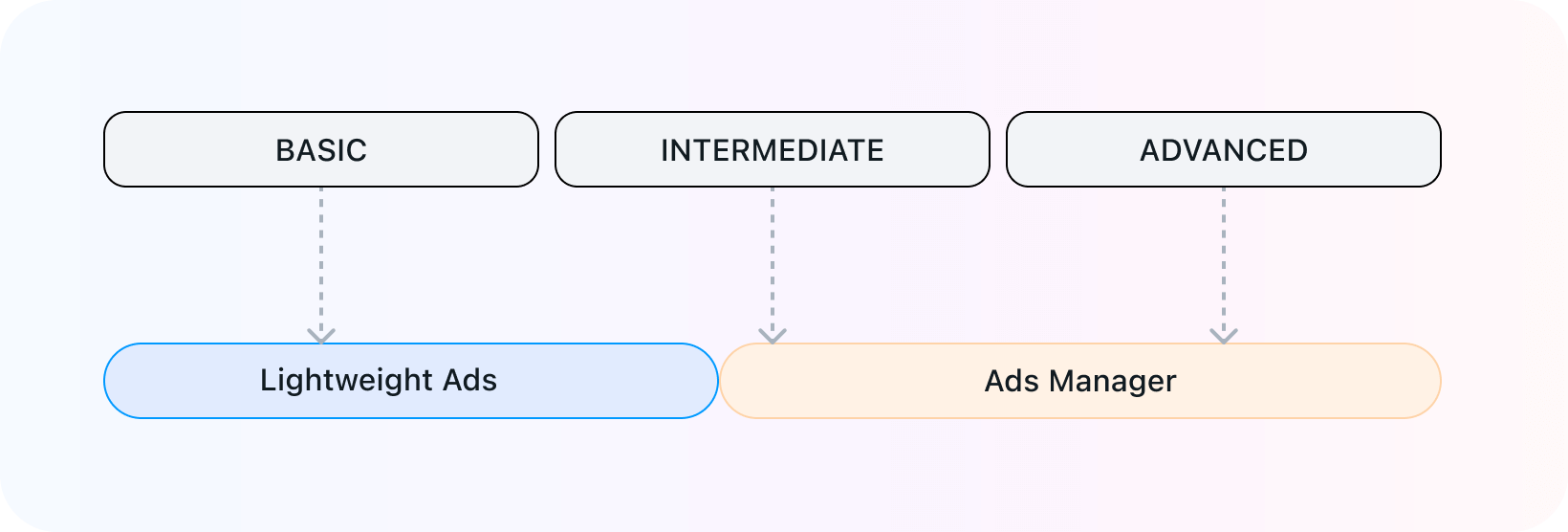
To support users of such varying sophistication, Meta offers two categories of tools:

  • Lightweight ads (LWI) — a simple tool built for novice advertisers with minimal marketing experience, targeting the basic and intermediate segments.
  • Ads Manager — the full-featured, robust tool with an advanced feature set, aimed at more sophisticated advertisers in the intermediate and large segments.
The two Meta ad tools mapped against advertiser sophistication
Two tools for a spectrum of advertisers: Lightweight ads for the basic end, Ads Manager for the advanced end.
The problem

An expanding family of apps, and a tool that couldn't keep up

Facebook has grown into a family of apps, including Messenger, Instagram, and WhatsApp, and many users promote their business primarily on one of them. An ad tool embedded only in Facebook left those users behind, so each app team set out to meet users where they were and support ad creation natively.

"As a small business, I'm not as familiar with other platforms' interfaces and language as I am with Instagram's. I find them difficult to understand, which demands a lot of effort to finish creating an ad."

Small business advertiser · research

"As a WhatsApp-only business, I don't expect — and don't want — to be taken to other platforms to create an ad. Today, when that happens, I give up on ad creation."

WhatsApp-only advertiser · research
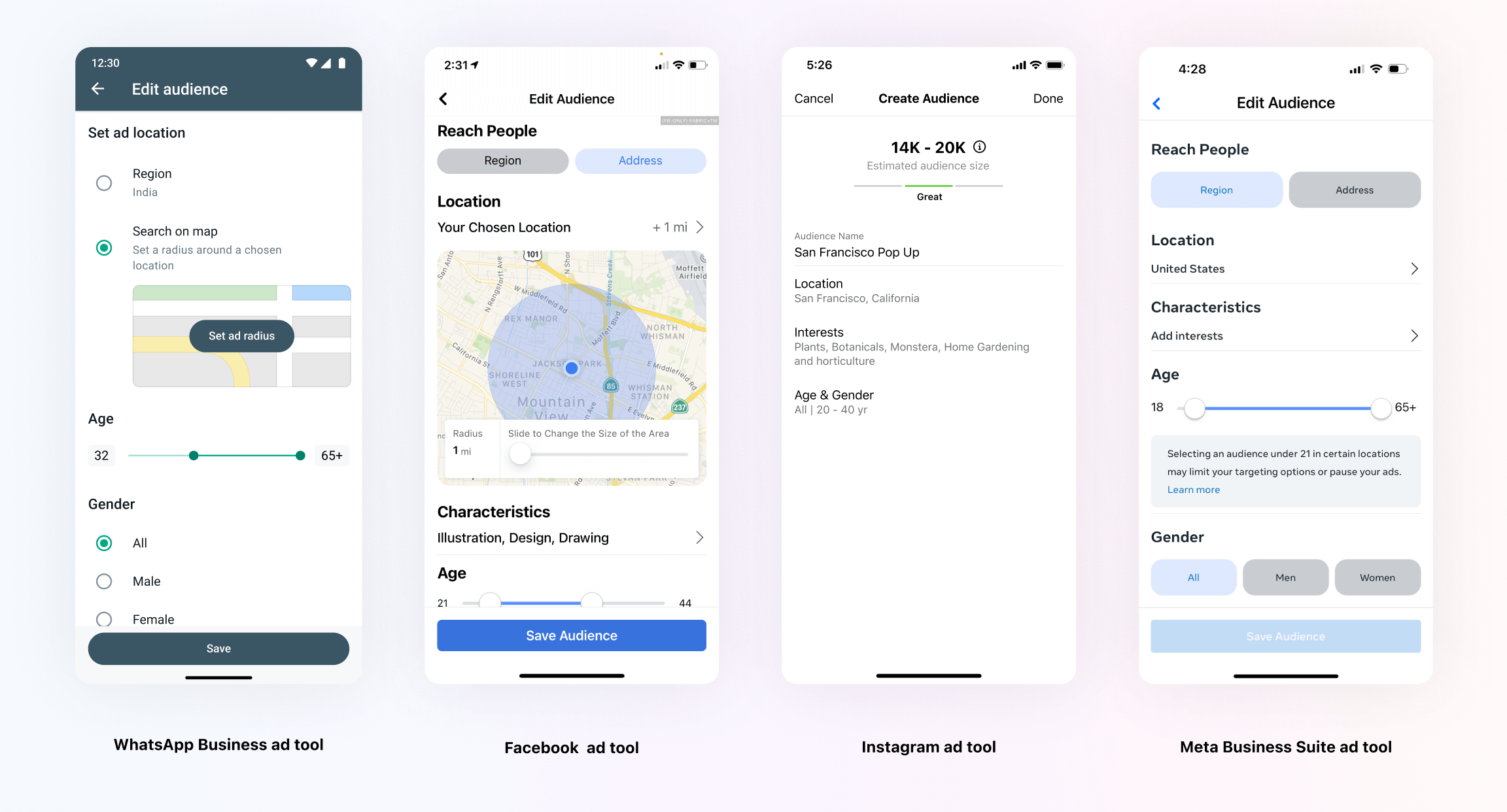
Similar ad functionality built differently across Meta apps
The proliferation of similar ad functionality, built differently across apps.
The solution

Shaping the Ads platform

Strategy & systems

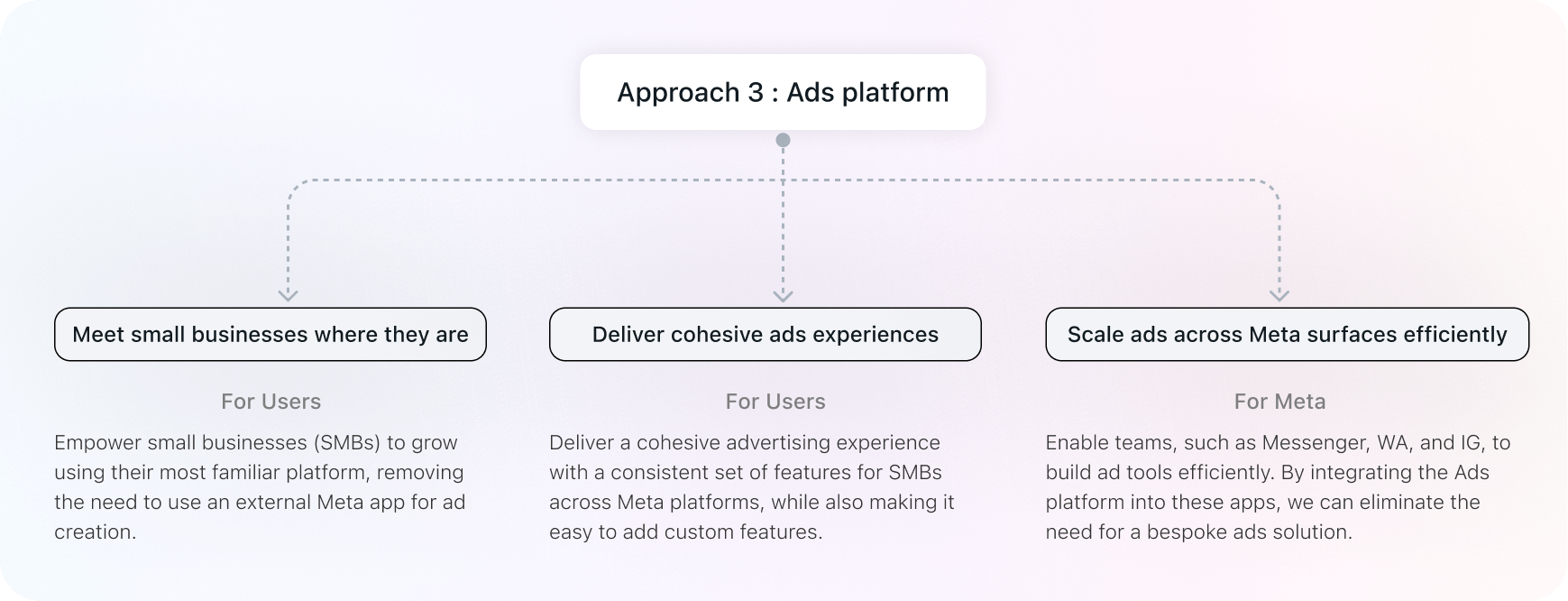
We developed an Ads platform that can be embedded into any Meta surface, so teams don't have to reinvent the wheel and invest in creating their own ad tool from scratch.

The Ads platform, native to each Meta surface and powered by one shared ad engine Ads platform
The Ads platform: native to each surface, powered by one shared ad engine.

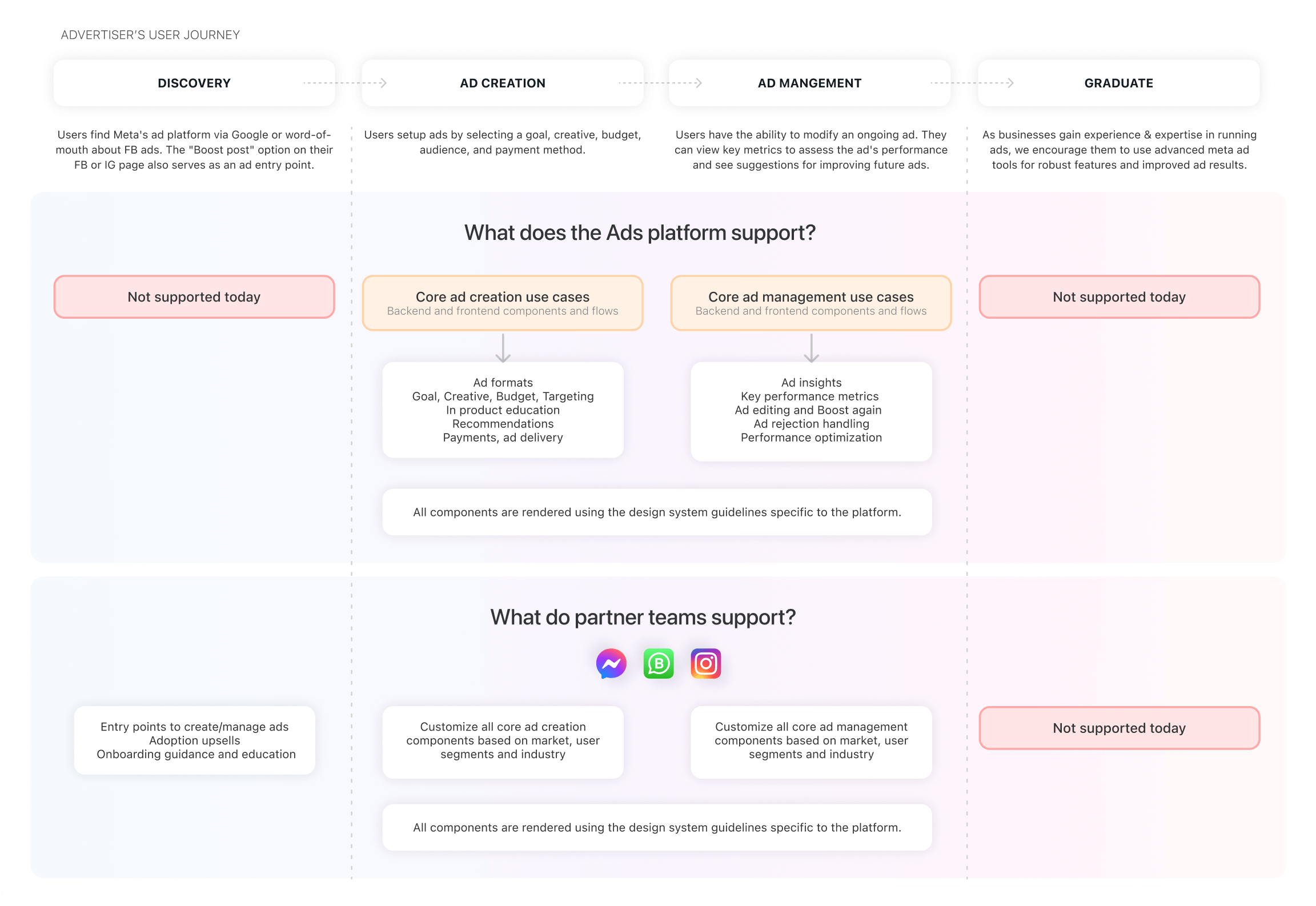
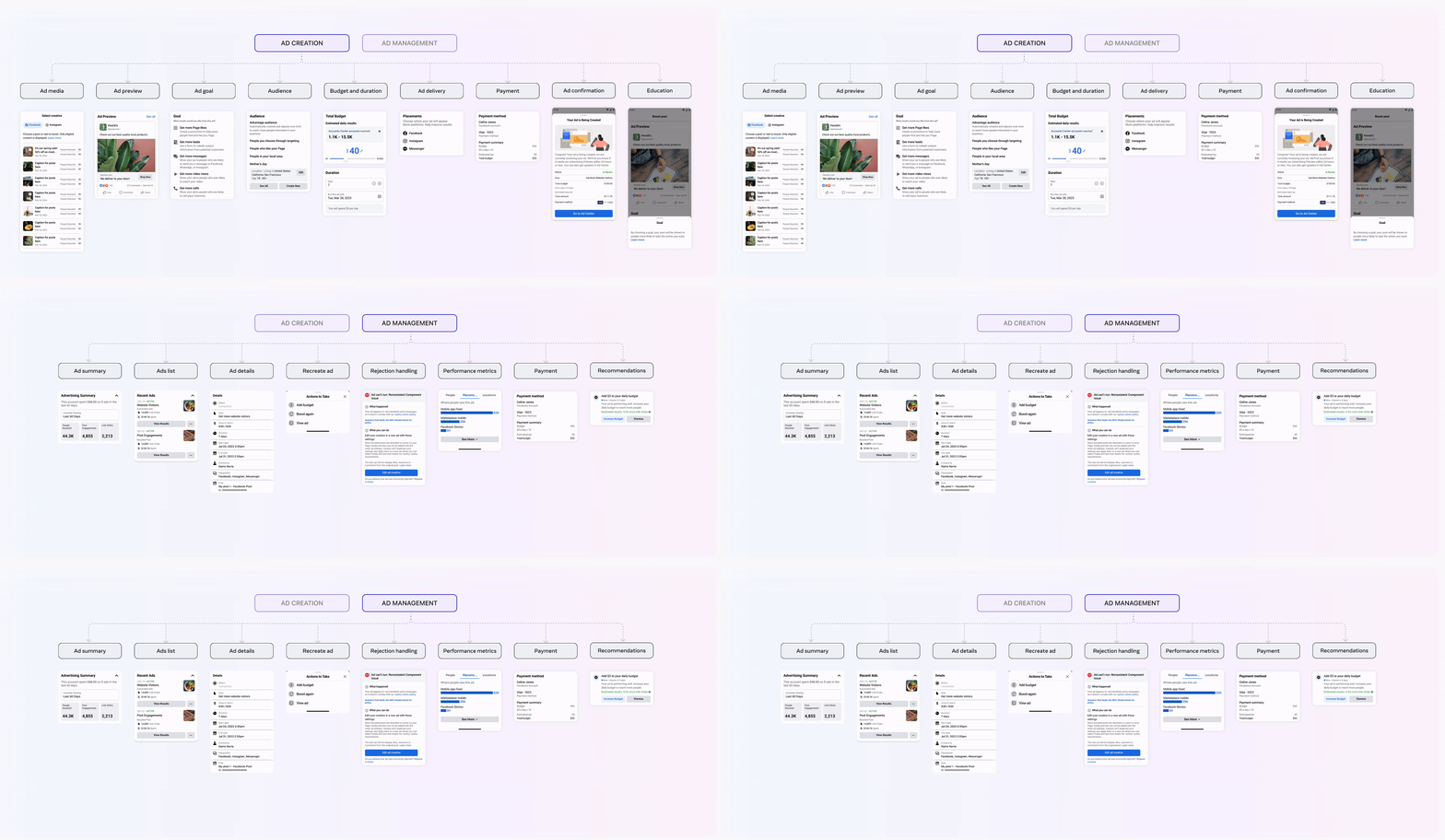
I first mapped out the advertiser's user journey, then evaluated which parts the platform could provide building blocks for: ad creation and ad management.

I broke these down into individual steps and identified how to split our monolithic application into discrete, logical "lego blocks." That's where I landed on the platform's two primary tenets:

The advertiser user journey, broken into building blocks
Mapping the advertiser journey, then breaking it into pluggable blocks.

Defining system tenets

Tenet 01

Composability

The blocks had to work together like pluggable legos, offered as a "menu of options." A partner team might not want to replicate the full ad experience — they should be able to pick the blocks that compose the right experience for their app.

Tenet 02

Adaptability

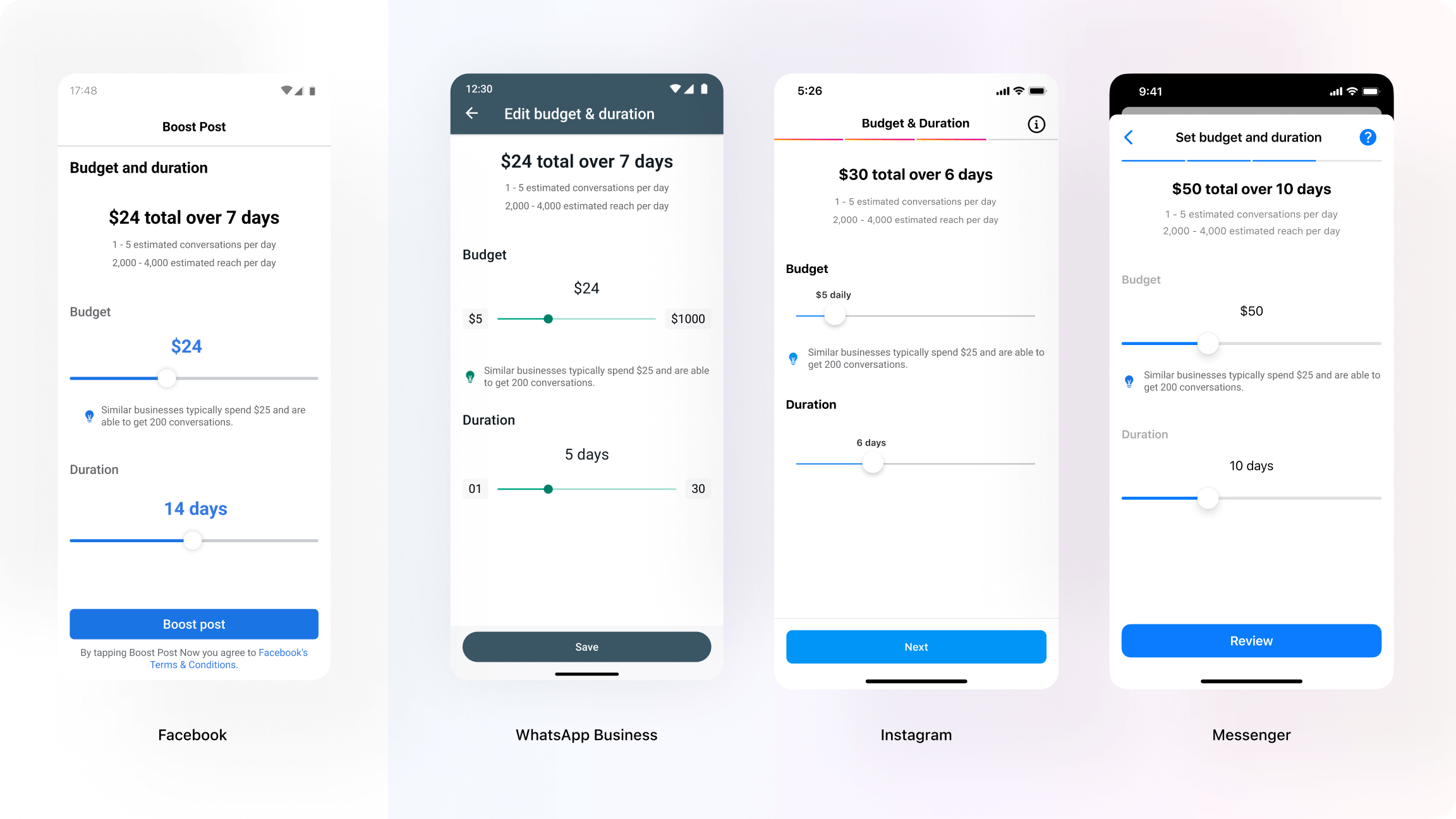
Design: each app has its own design system — visual language and components — so blocks had to adapt to the team's design system. Code: blocks had to be easy to adapt regardless of the app's backend or frontend technology.

Ad-creation blocks adapting to different surfaces
How a shared block adapts to feel native inside each partner app.

My contribution

This phase barely involved drawing new pixels. It was primarily strategic and systems thinking — figuring out how our existing ad tool could be abstracted into a usable platform. The few pixels I did draw painted the vision: how our blocks could be adapted by partner teams to deliver a consistent ads experience while still feeling native inside their own app.

Vision of platform blocks adapted across partner apps
The vision: one platform, many native-feeling surfaces.
First partner

"Platform, meet Messenger."

In our conversations, we learned Messenger was considering building its own native ad tool. We convinced them to partner with us and build on the platform instead, and Messenger became our first user.

Over the next 6 months, I embedded myself within the Messenger team, bringing my ads expertise to build a native ad solution inside Messenger, on top of the platform I'd designed.

Goal: empower messaging-active small businesses to discover, create, optimize, and manage performant ad campaigns right from Messenger.

Messenger × Ads Platform · north star

How businesses use Messenger today

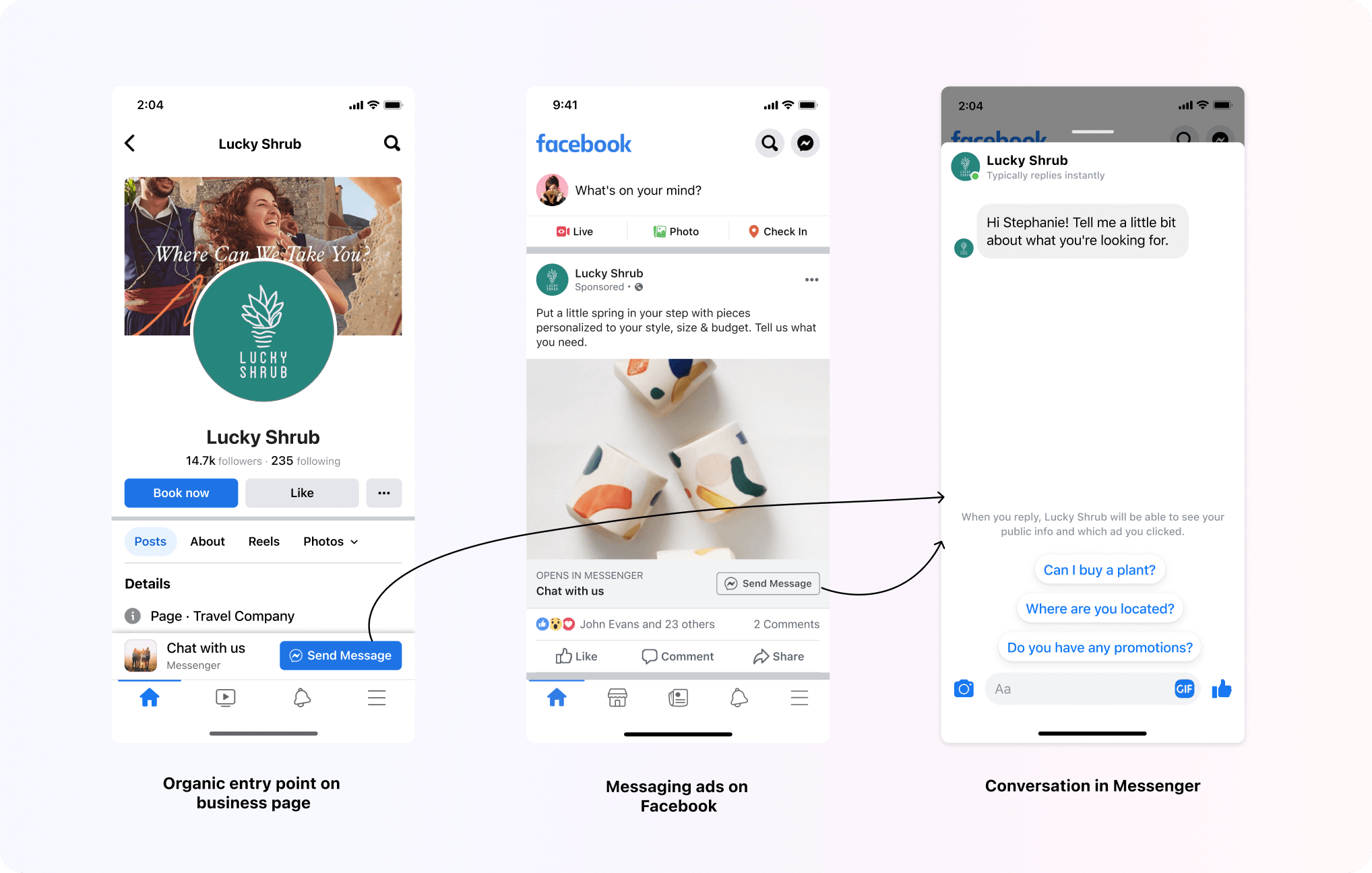
Small businesses use Messenger to engage customers through conversation — answering questions and making sales. They reach users by organically inviting them to "send message" from their Facebook business page, or by running messaging ads on Facebook.

How small businesses use Messenger to reach customers
How small businesses reach customers on Messenger today.
The process

Aligning three teams around one goal

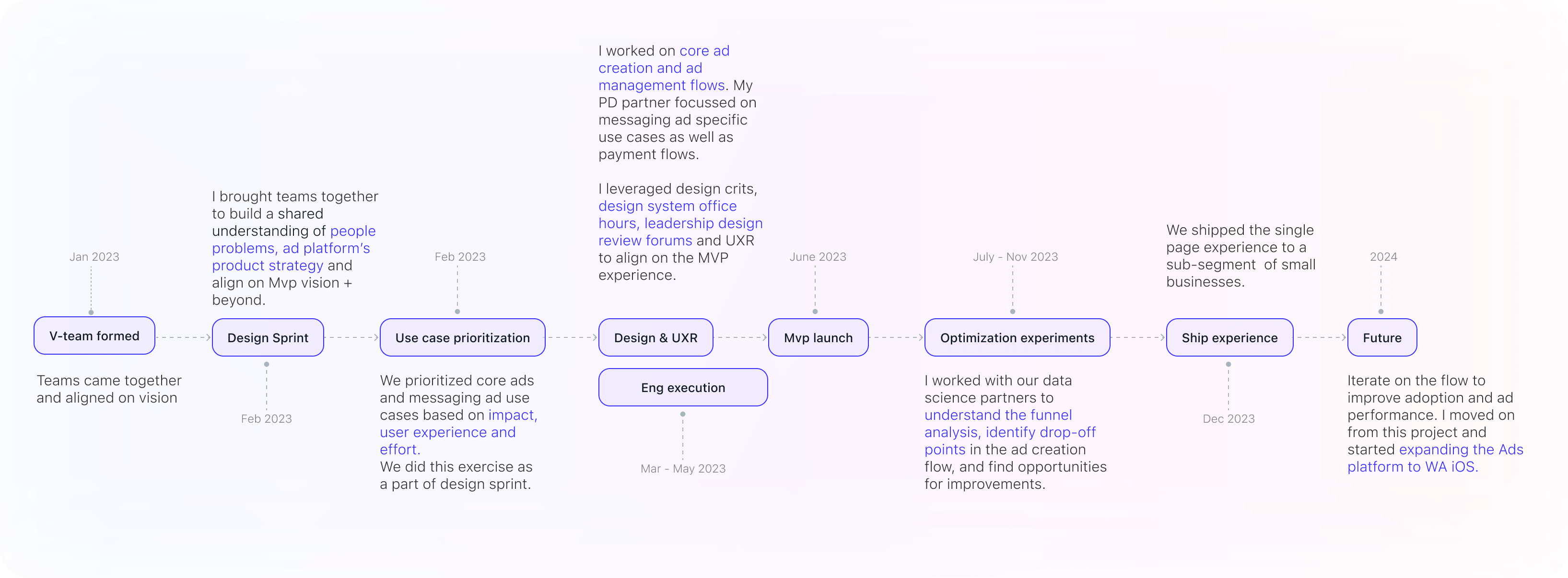
I organized a design sprint that brought together 25+ stakeholders across two organizations and three teams. It turned out to be crucial for building relationships and laying the groundwork for this 0→1 project.

The end-to-end process, from design sprint to launch
The end-to-end process, from design sprint through launch.

Driving alignment

The sprint built a shared understanding of our goals, the unique advertiser problems on Messenger, each team's long-term strategy, MVP prioritization, and early design explorations. It surfaced differing assumptions that had been quietly blocking alignment — and by the end, we'd come together as a single team with a unified goal.

Prioritizing features

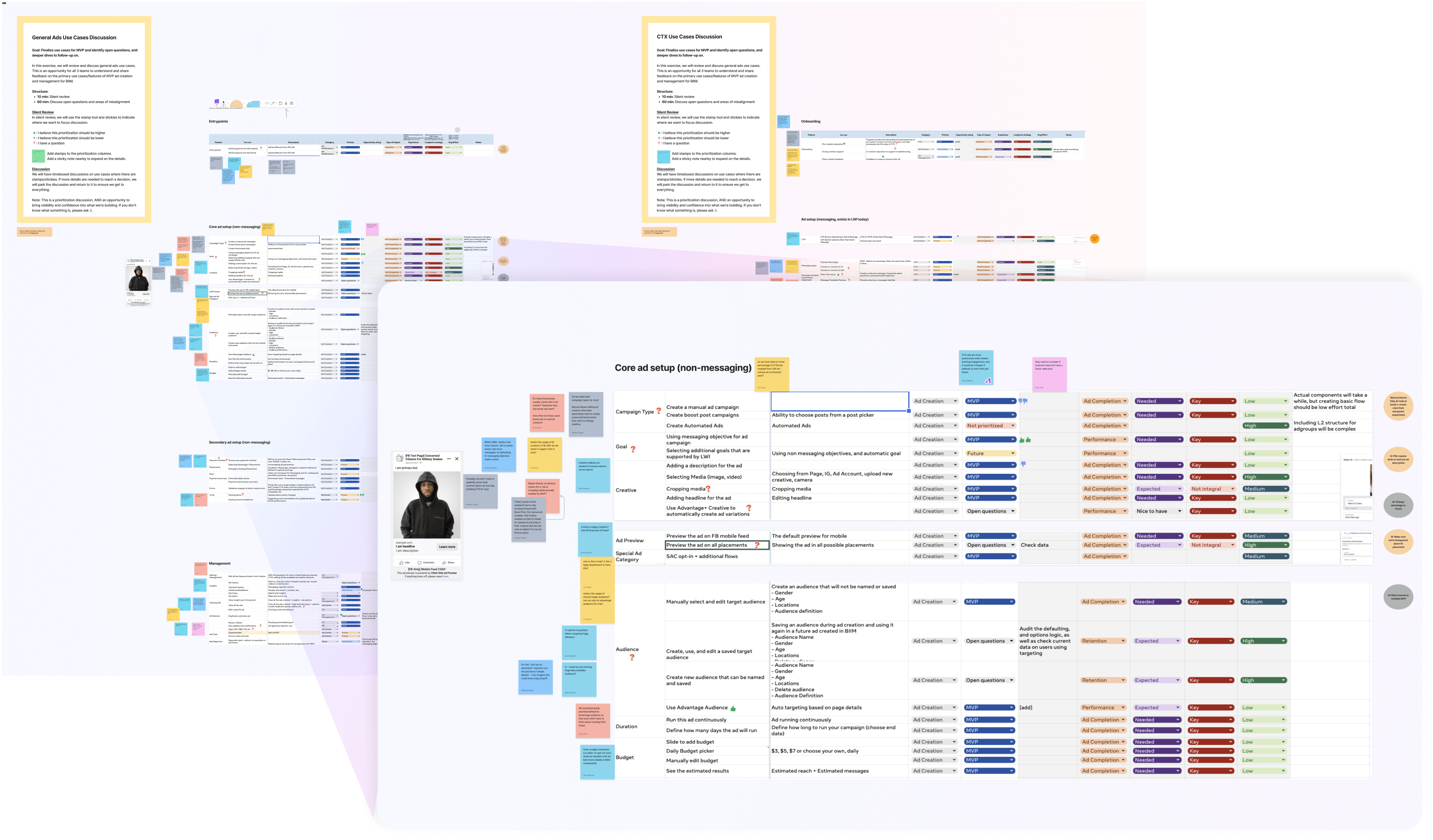
When my team collaborates with a partner, we bring core ads expertise while the partner brings deep knowledge of their vertical and surface. I documented general ad use cases while the Messenger team documented "messaging ad" use cases and north-star solutions.

We evaluated each feature by impact (adoption, completion, performance, retention), experience (needed, expected, nice to have), strategic relevance (key vs. not integral), and eng/design effort (low, medium, high) — then prioritized each into MVP, fast-follow, or future, and worked through the items where we disagreed.

Feature prioritization framework from the design sprint
Scoring and prioritizing features across impact, experience, strategy, and effort.

Design principles

From what people, platform, and product experts shared in the sprint, we distilled three guiding principles:

Principle 01

Lightweight

In priority markets, connectivity is a real constraint. A simplified experience where advertisers can easily access, create, and manage ads is key for SMBs.

Principle 02

Personalized

Recommendations reduce cognitive load, help advertisers create better-performing ads, and build trust over time.

Principle 03

Supportive

Our advertisers are often inexperienced solo entrepreneurs — so we guide them at every step, without overwhelming them.
What I designed

From lego block to native Messenger flow

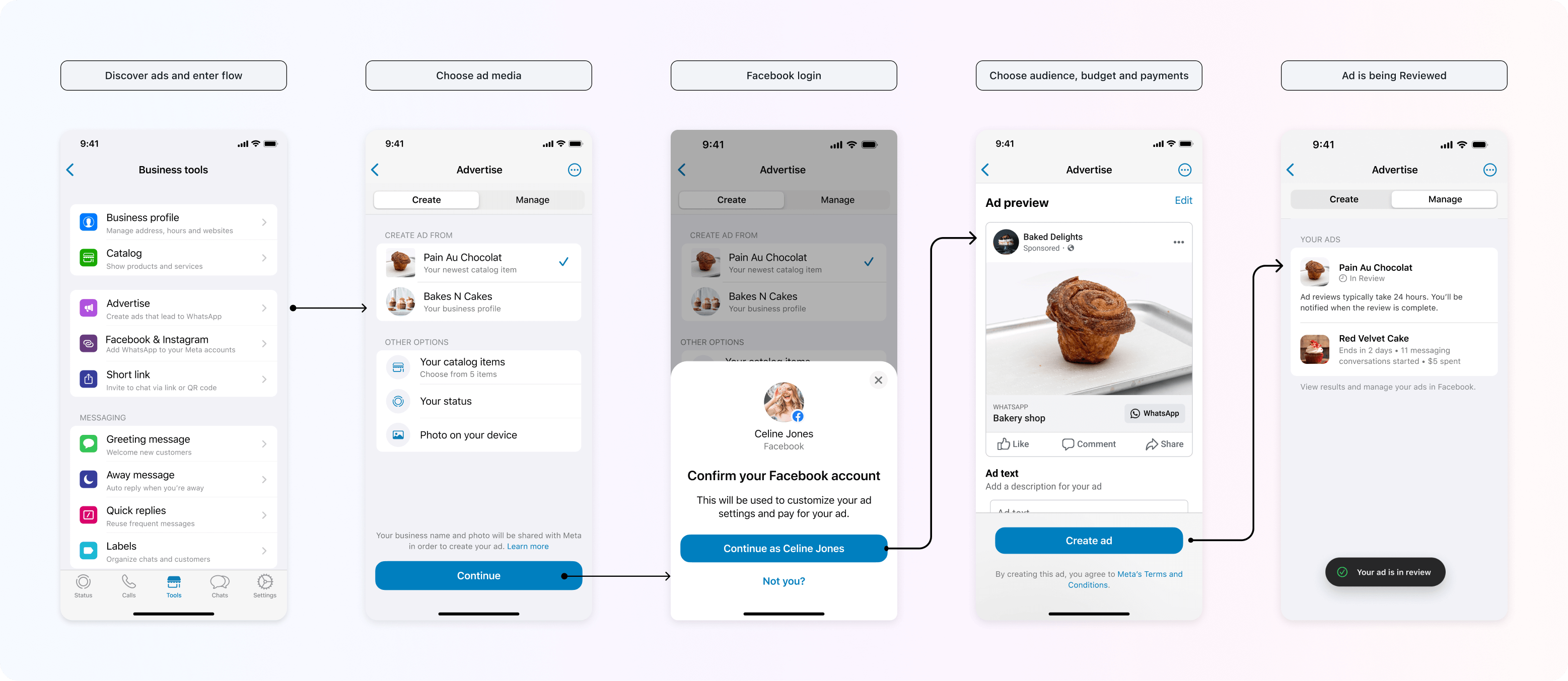
Ad creation

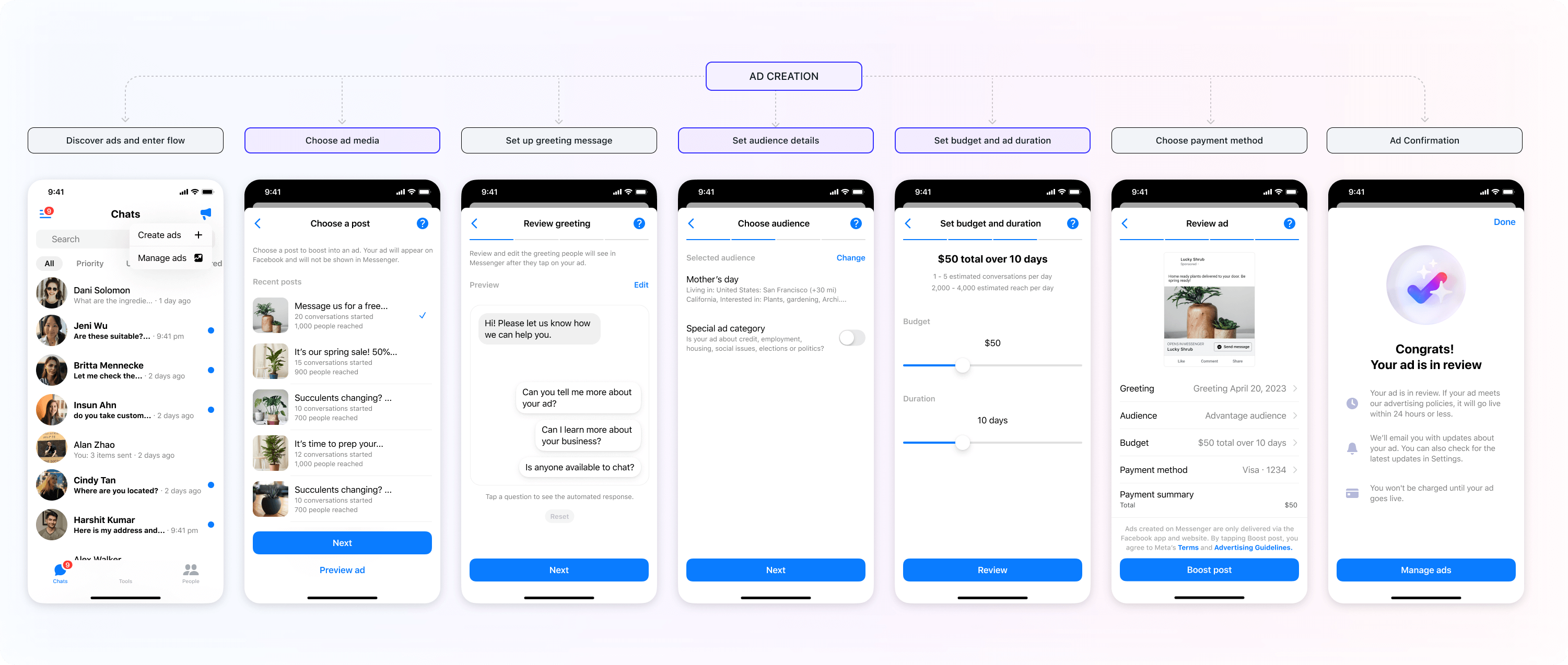
This is the final end-to-end ad-creation journey, as implemented in Messenger.

The final end-to-end ad creation journey in Messenger
The end-to-end ad-creation journey, native to Messenger.

Sub-journey: set audience details

User needs

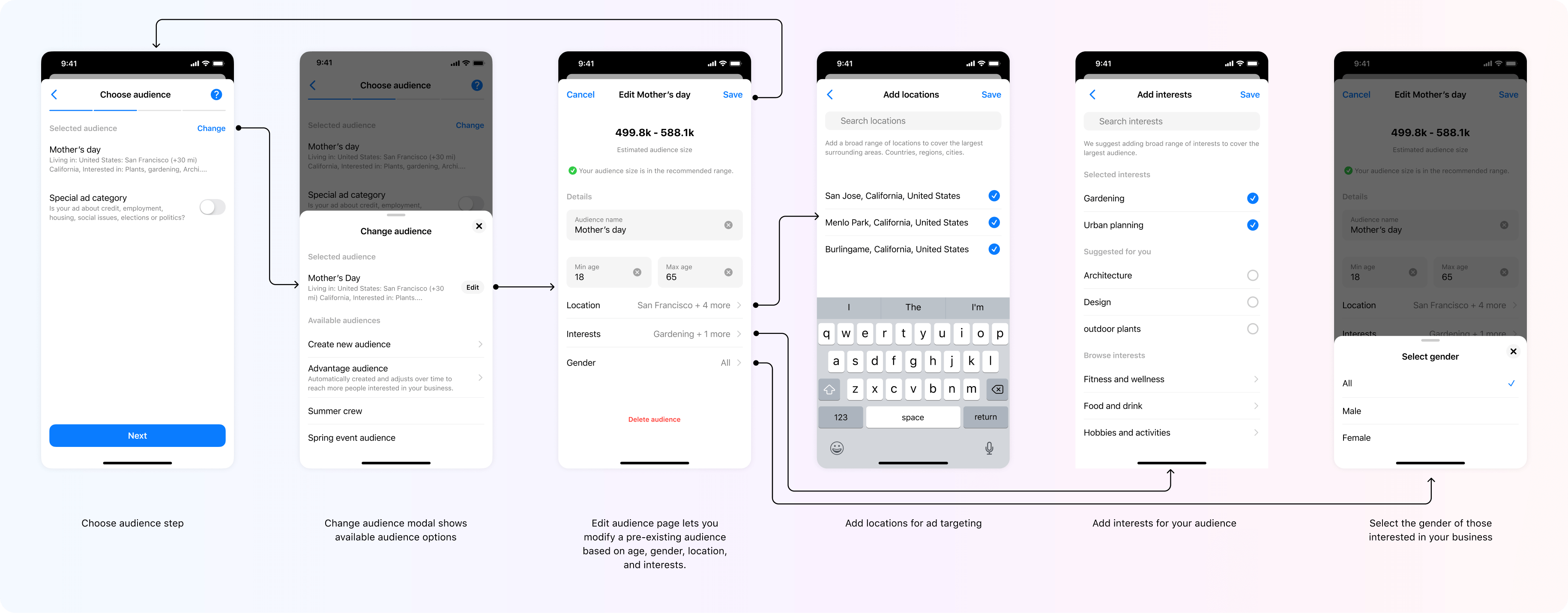
  • Help me get started quickly, without needing to deeply understand how targeting works — give me smart defaults.
  • More advanced advertisers need more control.
  • Everyone needs a way to efficiently reuse (and edit, if needed) a previously created audience.

What the Ads platform provides

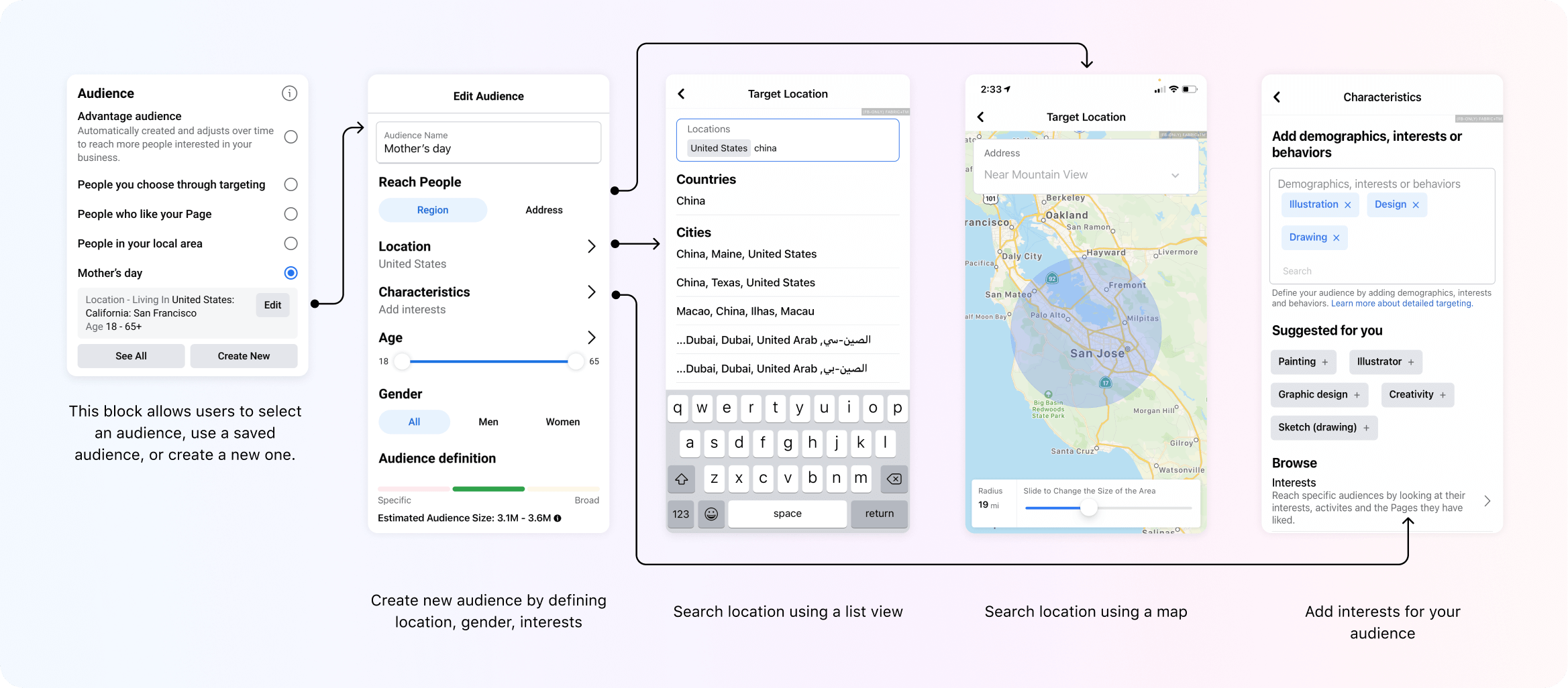
  • Advantage audience: a Meta-recommended audience that uses an ML model to predict personalized targeting settings.
  • Edit / custom audience: create a custom audience by choosing targeting locations and interests.
Audience details as provided by the platform blocks
Audience details sub-journey – As provided by platform Blocks
Audience details translated natively within Messenger
Audience details sub-journey – As translated within Messenger
What I designed

Making performance legible, natively

Ad management

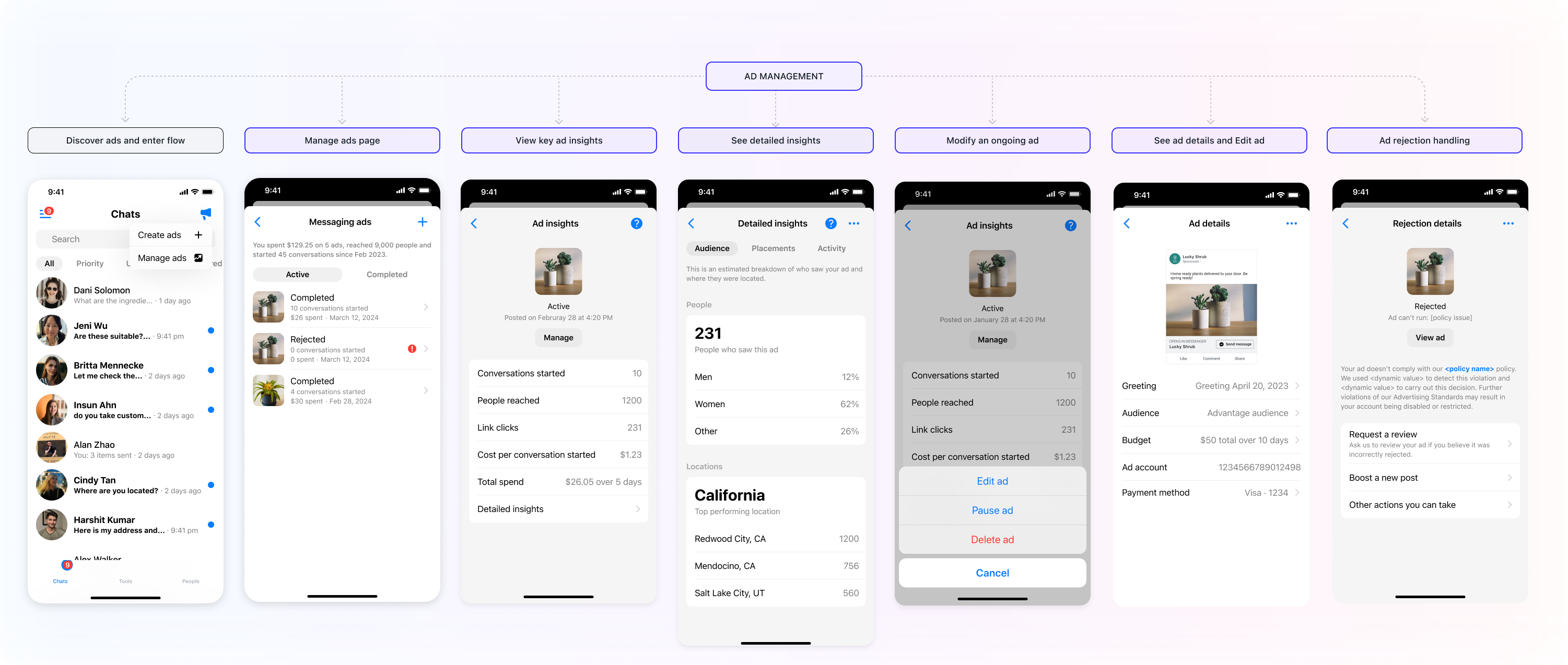
This is the final end-to-end ad-management journey, as implemented in Messenger.

The final end-to-end ad management journey in Messenger
The end-to-end ad-management journey in Messenger.

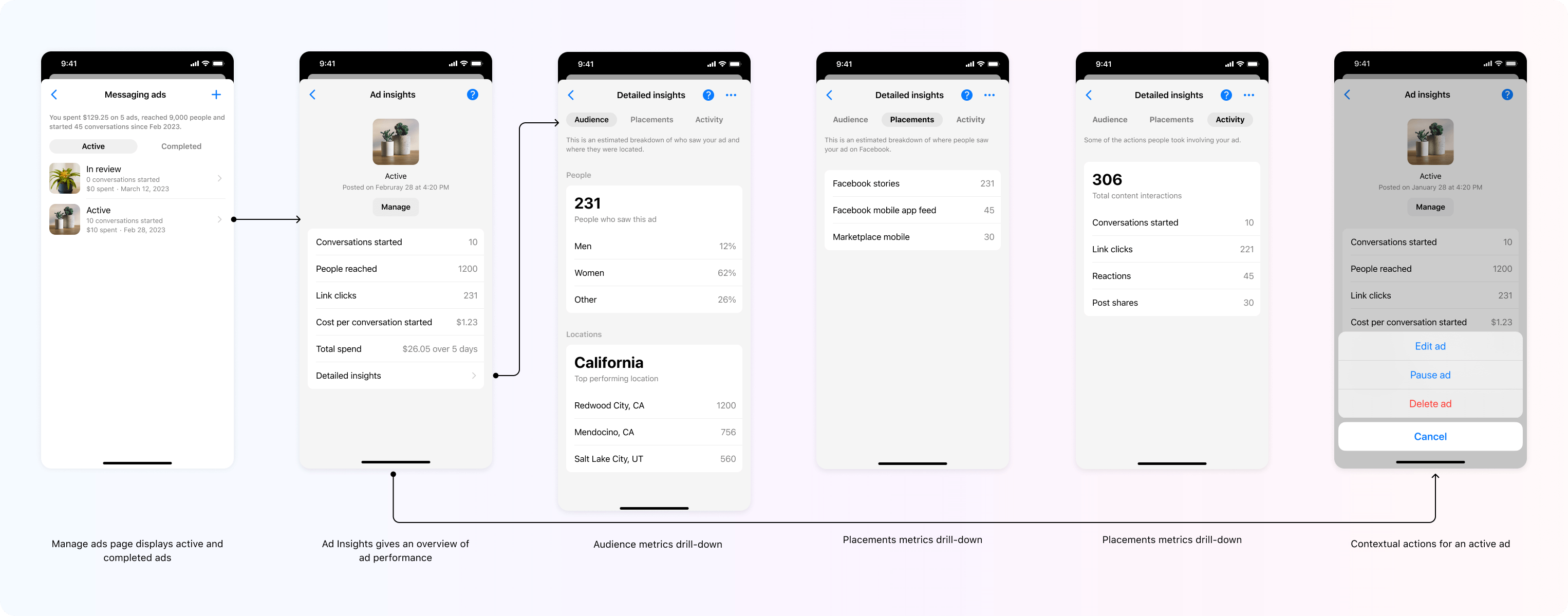
Sub-journey: ad insights

User needs

  • Manage: make changes to an ongoing ad.
  • Measure: understand the ad's performance — and whether it was "worth it."
  • Learn & act: understand what drove success or failure, and how to improve ongoing and future ads.

What the Ads platform provides

  • All the core components for ad management: modify an ongoing ad, handle ad rejection, and recreate an ad.
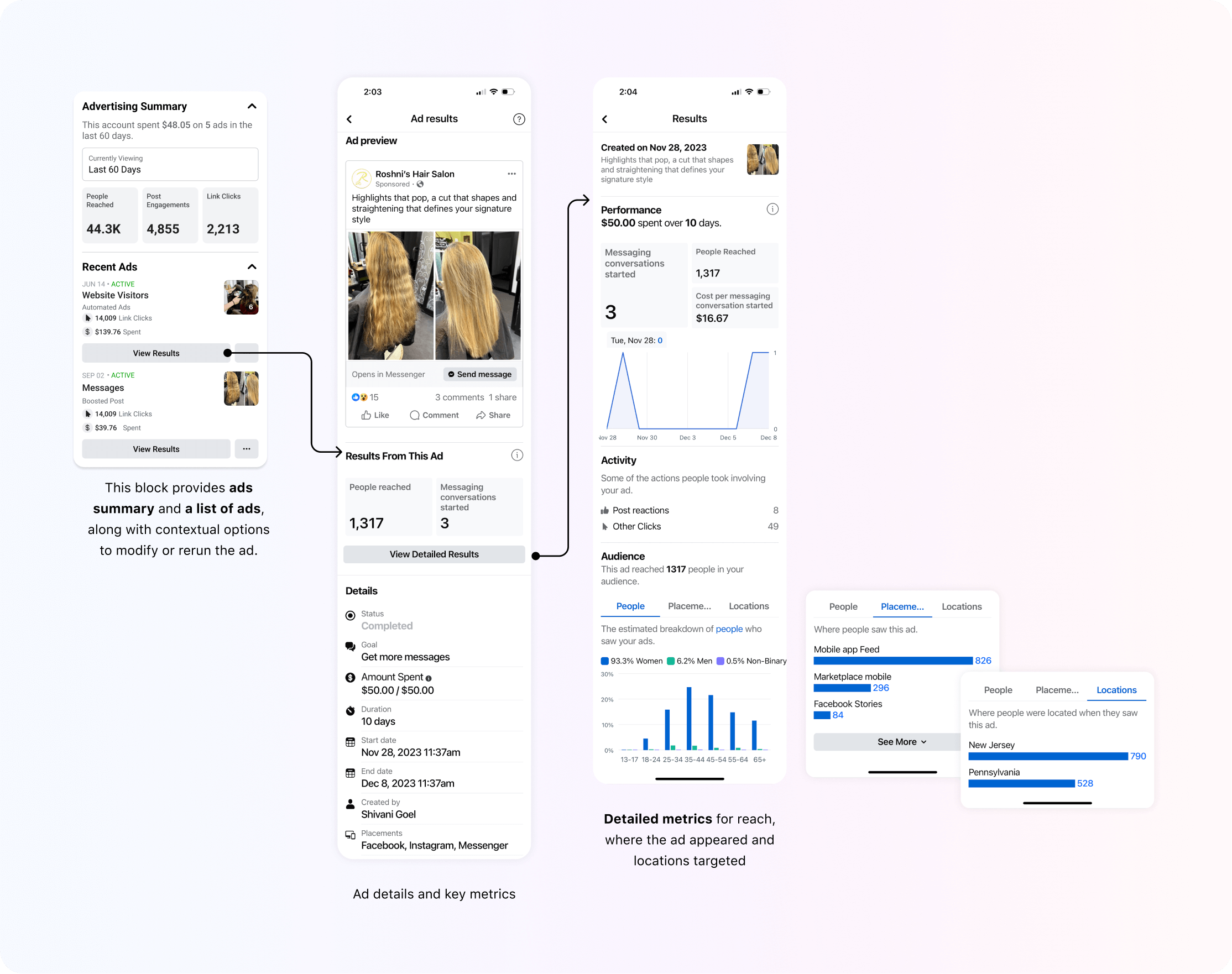
  • Key performance metrics plus recommendations to improve future ads.
Ad insights as provided by the platform blocks
Ad insights sub-journey – As provided by platform Blocks
Ad insights translated natively within Messenger
Ad insights sub-journey – As translated within Messenger
Impact

The work moved the business

In Q4 2023 we launched the Messenger ad-creation experience — driving an annualized revenue impact of approximately $20M.

~$20M
annualized revenue impact
ad completion (1.3% → 4%)
+38%
messaging-ad creation attempts at the entry point

Introducing the native experience roughly tripled ad completion in Messenger. It's a substantial jump, though still short of the ~11% benchmark on the Facebook ad tool — which is expected, given that tool's decade of optimization.

Next steps

In early 2024 I transitioned to scaling the ads platform on WhatsApp for iOS, while the Messenger team continued funnel analysis and optimization — enhancing top-of-funnel adoption and adding features to improve comprehension and retention.

2024 → WhatsApp

I embedded myself in the WhatsApp team to bring a native ads experience to the iOS WhatsApp Business app using the Ads platform. Today WhatsApp deep-links out to the Facebook ad tool for ad creation — the platform is how we bring it home.

Bringing native ad creation to the WhatsApp Business app
Next surface: a native ads experience inside WhatsApp Business for iOS.
Reflection

What building 0→1 across orgs taught me

1Cross-org collaboration is the real skill

Over 1.5 years immersing myself in partner teams, the one skill I've had to develop and lean on most is collaborating with cross-functional partners spread across different organizations.

It means quickly adapting to different platforms and design systems, understanding each team's unique users and challenges, and integrating the ad platform to meet those needs — often across differing opinions, goals, and assumptions.

2Documentation is a design tool

Documentation streamlined communication and made collaboration possible on a project this large. Two documents did the heaviest lifting:

Design execution — outlining scope, ownership, progress, user insights, and review timelines, keeping my design partner and me working toward a common goal.

Variants, new components & patterns — capturing where existing Messenger components fell short, and the rationale for a variant or a net-new component. It informed design decisions and guided conversations with the design-system teams.